Hollow Reed
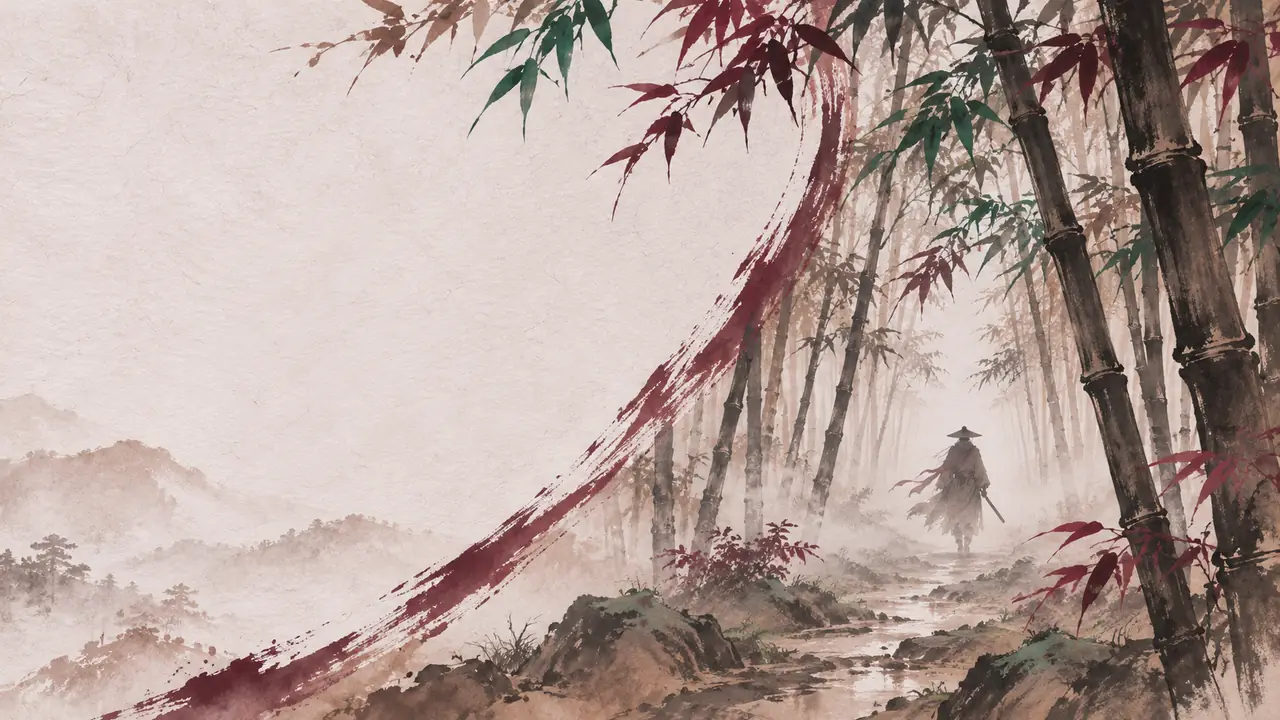
When the path narrows, count the places where you can still turn.
A notice at the clearing in Hollow Reed
Hollow Reed is an ink-wash wuxia concept about a traveler and a rival on opposite sides of a bamboo grove. The paths are close enough to hear but not close enough for either figure to see the other clearly. A breeze can move the leaves across the whole clearing. A footstep moves a small cluster. The player waits, chooses a position, and follows what the rival understood about that choice.
The entrance is part of the encounter
A torn paper notice hangs on a cord near the west clearing. Beyond it are a stream bed, a dry stone and a worn path that curves toward the center. The notice gives a reason to look at the road behind the traveler before advancing. The stream bed hides a silhouette but carries the sound of a misstep. The stone has more room on one side than the other. None of the paths is quiet in every condition.
Listen, step, then read the new clearing
Begin a turn by watching the leaves from the edge of the scene. The ambient movement has a recognizable rhythm, while an isolated change may indicate where the other figure has stopped. Choose a position, then allow the rival to respond. The response can reveal what the rival heard or where the path now leads. The player sees the result from the new position, with the original path still visible when the grove allows it.
Waiting can make a signal clearer and can give the rival time to move behind a wider clump of bamboo. Repeating the same wait forever should not be an easy way to turn imperfect information into certainty. The test needs a readable state change during the wait. Let a brief pause carry one meaning in a sheltered hollow and another near the moving water.
An ink wash that keeps its outlines
The illustration separates the pale ground, rust-brown trunks, jade leaves, and one burgundy stroke across a page. Ordinary wind is a soft wash along a whole cluster. Disturbance appears as a readable change of direction in a smaller group, with shape and spacing carrying the signal alongside color. The drawing should work as a still frame. Motion and sound then add a sense of pace rather than withholding important information from players who cannot hear it or prefer fewer effects.
The next test
The concept is in early development. We plan two openings using the same clearing. One begins close to the water, with signals easy to see and difficult to place. The other starts behind the notice, where the traveler can hear a movement before seeing it. Ask the player to name which fact changed their decision and what they expected the rival to know. If they can only name the bright mark, revise the scene. Heron Roofs asks related questions about landing geometry and being heard from below. The Schools index connects both lines through their teaching scenes.