Heron Roofs
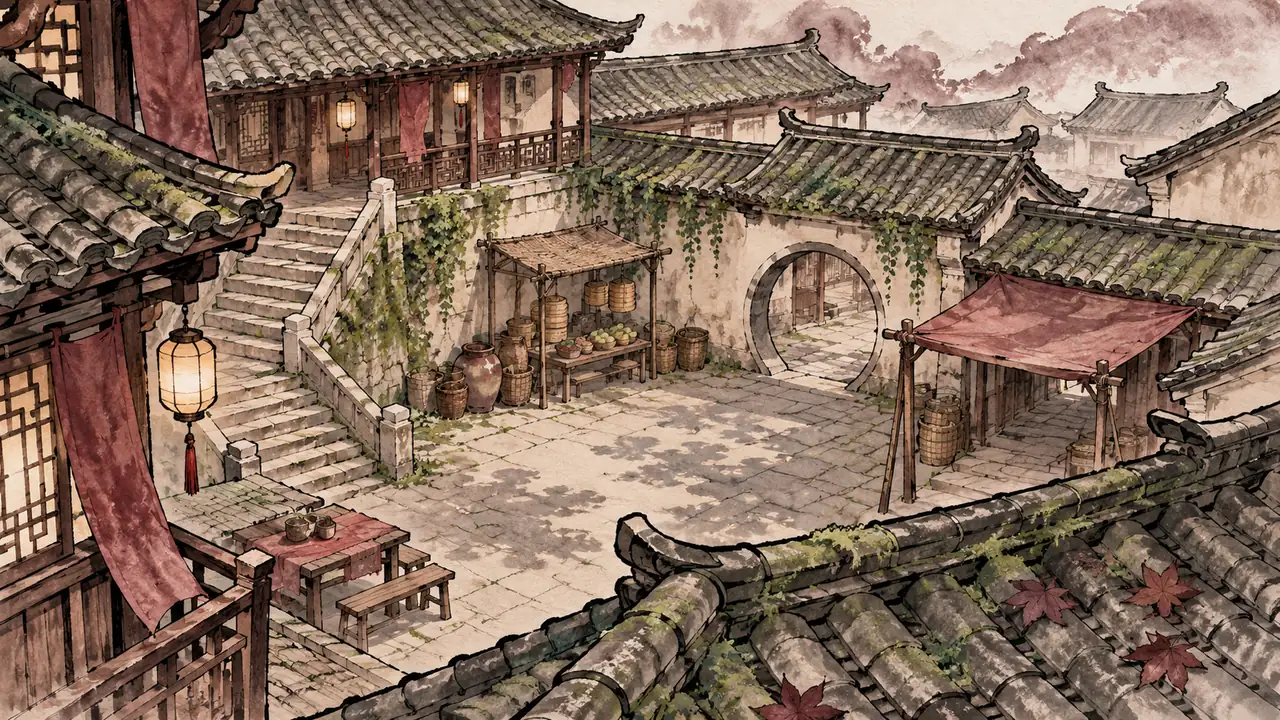
Heron Roofs is a concept for an ink-wash wuxia game about crossing a market lane and deciding how to enter a courtyard. The traveler begins above the copper awning while a rival waits near a closed gate. The scene asks the player to read two or three roof edges before choosing an approach. Each path tells the rival something about where the traveler is coming from.
The landing proof
- Read the near eave. Its lower clay tiles end at a pale edge. The next roof begins below it and farther into the lane.
- Choose the height. From the ridge the traveler can see the whole courtyard. From the awning the traveler can see the gate and the stone below it.
- Settle the approach. The first landing establishes where the traveler stands when the rival looks up. The scene holds at that point until the player commits to entering.
The player may examine a route before taking it. While perched, they can plan one leap and preview the approximate landing zone. The preview lives against the roof plane so it remains legible in a flat drawing. The next view reveals what the rooftop blocked. It is a consequence of position, with the surrounding lane preserved so the player can recognize the place from a different angle.
From the copper ridge to the closed gate
The market lane has a roof above its outer stair and a narrow awning stretching from a shuttered tea shop. Below that awning, the courtyard path bends before it reaches the gate. The ridge offers the clearest view and carries the loudest landing. The lower route can keep the rival from anticipating the traveler until the last turn, but it commits the traveler to an approach with little visibility around the bend.
After the first approach, the player sees a brief response from the rival. The response expresses what the rival could reasonably infer from the noise and angle. The point is for both participants to occupy a scene the player can still read after the camera changes. A landing can be successful and still leave the next exchange more difficult.
Brushwork as geometry
Dark strokes describe the planes the traveler can stand on. Thinner marks suggest rough surfaces and slope without implying extra platforms. A pale wash behind the roofs holds the depth cue. It changes in density between the copper ridge and the awning so the player can see which edge is nearest even when the traveler stands against it. The courtyard has a softer finish until the view drops close to ground level.
First prototype
The first test will show someone two landings and ask them to point to the next usable edge before moving. Then it will repeat one approach with the contrast reduced and the same geometry. We want to learn which strokes genuinely support navigation. Later tests can ask whether the rival’s response is understandable from the position and sound. Hollow Reed explores rival cues in a clearing, and the Schools chart shows how the two concepts are related.